The documented history of Cacela Velha: Roman occupation, the Islamic town of Hisn Kastala, the Christian conquest, the 1755 earthquake, the rebuilt fort and the archaeological digs. With a source for every fact.
Cacela Velha looks small and quiet, but beneath its whitewashed houses lies more than two thousand years of settlement: a Phoenician-Carthaginian trading post, a Roman military base, an Islamic town with a famous poet at the court of Córdoba, a castle fought over during the Reconquista, and a fort rebuilt after the 1755 earthquake. This article gathers what is documented about that history, with the source for each fact, to separate historical record from legend or oral tradition.
Whenever a date or fact comes from a single secondary source, or is described as legend or hypothesis, that is stated in the text. The full source list is at the end of the article.
Quick answer: the timeline
- Prehistory and the Punic period: evidence of human occupation in the region since prehistory; the settlement is thought to have served as a trading post for Phoenicians and Carthaginians.
- Roman period: Rome chose Cacela as a military base; Roman kilns survive on the site.
- 713–1240: Islamic rule. The settlement, known as Hisn Kastala or Qastalla Darraj, was the seat of a territory more important than Tavira's at the time.
- 1240: Christian conquest of the castle, handed to the Order of Santiago.
- 1283: King Denis grants Cacela a charter (foral) on 17 July.
- 16th century: the current Renaissance-style parish church is built.
- 1755: the 1 November earthquake badly damages the church, the fort and the town hall.
- 1770–1794: the fort seen today is rebuilt.
- 1775: the Cacela municipality is abolished; its territory passes to the new Vila Real de Santo António.
- 1833: a Liberal force of about 2,500 men lands nearby during the Portuguese Civil War.
- 1996: the historic core is listed as a Property of Public Interest.
- 1998–2022: archaeological digs uncover an Islamic quarter and a medieval Christian cemetery.
Before written history: from prehistory to Rome
The official listing record of Portugal's heritage authority, the Direção-Geral do Património Cultural (DGPC), summarises the area's earliest occupation like this: the first settlement of the peninsula where Cacela stands is thought to date from the pre-Roman period, tied to the sea and the lagoon's natural conditions, and "Cúneos an ancient Iberian people], Phoenicians and Carthaginians are thought to have settled here, turning it into an important trading post closely linked to the Mediterranean." Later, "the Roman Empire chose Cacela as its military base" ([DGPC).
Wikipedia adds that Cacela "was a passage point for Greek and Phoenician sailors" and that, according to some authors, it may have been Cunistorgis, the ancient capital of the Cúneos people — a hypothesis, not an established fact (Wikipedia). Roman-era pottery kilns survive on the site as an archaeological trace of that period.
Hisn Kastala: the Islamic town (713–1240)
Cacela came under Muslim rule in 713, during the campaigns of Abd al-Aziz ibn Musa in the Algarve and Lower Alentejo. Part of the cora (district) of Ossónoba (Faro), the settlement was known by several Arabic names — Hisn-Kastala, Qastallat Dararsh, Cacetalate or Cacila — and was controlled by the Banu Darraje (or Banu Daraj) clan (Wikipedia).
Defended by a 9th–10th-century castle with a maritime-agricultural character, Cacela reached its peak during the Islamic period. According to the DGPC, "Cacela was the seat of a vast surrounding territory, with a status higher than Tavira's" (DGPC). It was in this era that the town's most famous native lived: the poet Ibn Darraj al-Qastalli, born in 958 (year 347 of the Hijra). He entered the service of the Córdoban ruler Almanzor around 992, after an improvised poem, and later served the court of the Taifa of Zaragoza; he died in Dénia in 1030 (Wikipedia; Tahiri, 2009).
A Mozarab Christian community also lived under Islamic rule: at Fonte Salgada, nearby, the tombstone of Bishop Iulianus was found, dated to the 10th century, which the DGPC describes as of "unparalleled quality in Portugal," close to the Mozarab erudition of Seville and Córdoba (DGPC).
Excavations at Largo da Fortaleza in 2007 uncovered the remains of a 10th-century medina — Qastalla Darraj — including what is thought to be the house of a qadi (an Islamic magistrate), seven grain silos (five of them unusually large, an archaeological rarity) and domestic pottery. The quarter was abandoned before the Christian conquest of 1240 (Notícias de Arqueologia; CIIPC).
The Christian conquest and King Denis's charter (1240–1283)
Local tradition, recorded on Wikipedia as legend rather than historical fact, tells that D. Paio Peres Correia conquered Cacela in 1240 after agreeing a truce with the Moors; seven Christian knights were then supposedly killed by treachery, which is said to have driven D. Paio to attack and also conquer Tavira (Wikipedia). What is documented is that the fortress was one of the last castles in the Algarve to be taken from the Moors, and that King Afonso III granted it to the Order of Santiago, which carried out building works there — part of the wall built at that time now lies submerged (DGPC). Administration of the surrounding land was entrusted to a commander appointed by the Order (Wikipedia).
On 17 July 1283, King Denis granted Cacela a charter (foral), a document now kept at the National Archive of Torre do Tombo, in the Chancery of King Denis. The municipality of Cacela then included parts of what are today the parishes of Azinhal and Odeleite (PlanetAlgarve; Wikipedia).
From medieval decline to the 1755 earthquake
Through the 14th century, changes in the coastline and pirate attacks led the population to abandon the town and scatter to farms further inland, a trend that is thought to have grown from the Age of Discovery onward. A document from 1465 states that there were no houses left beyond the castle, where the commander lived; a 1617 drawing shows a nucleus made up of the fortress, the church, the prior's houses, the town hall and a pillory, with the inhabitants living outside the town. From 1621 comes the "Relação e Traça da Vila de Cacela" (Account and Plan of the Town of Cacela), by Alexandre Massai (Wikipedia).
The earthquake of 1 November 1755 struck Cacela hard. A period account, published in a pamphlet titled "Relaçam do terramoto do primeiro de Novembro do anno de 1755," describes the damage: "in the Town of Cacela (…) the parish church, the Misericórdia and the Town Hall were ruined; and at the neighbouring Fortress the bastions fell with such violence that they threw the mounted cannons onto the beach" (Wikipedia). A "Topographic map of the commons and uncultivated lands of the municipality of Casella," from 1775, shows the urban core already rebuilt, with a church, fortress, pillory, priest's house, town hall, jail and the governor's houses.
The medieval-origin church and the rebuilt fort
The current parish church of Nossa Senhora da Assunção preserves, in a small north-facing side portal, a Gothic trace of the original medieval building, from the late 13th century. Sources do not fully agree on the exact date of the building seen today: Wikipedia states it was built in 1518 over the medieval ruins (Wikipedia), while the DGPC attributes the design to André Pilarte — a master builder active in the Algarve between 1517 and 1551, also responsible for the Misericórdia church in Tavira and the parish church of Alcoutim — and dates the work to "around the middle of the 16th century" (DGPC). The main portal is Renaissance in style, with sculpted busts of Saint Peter and Saint Paul.
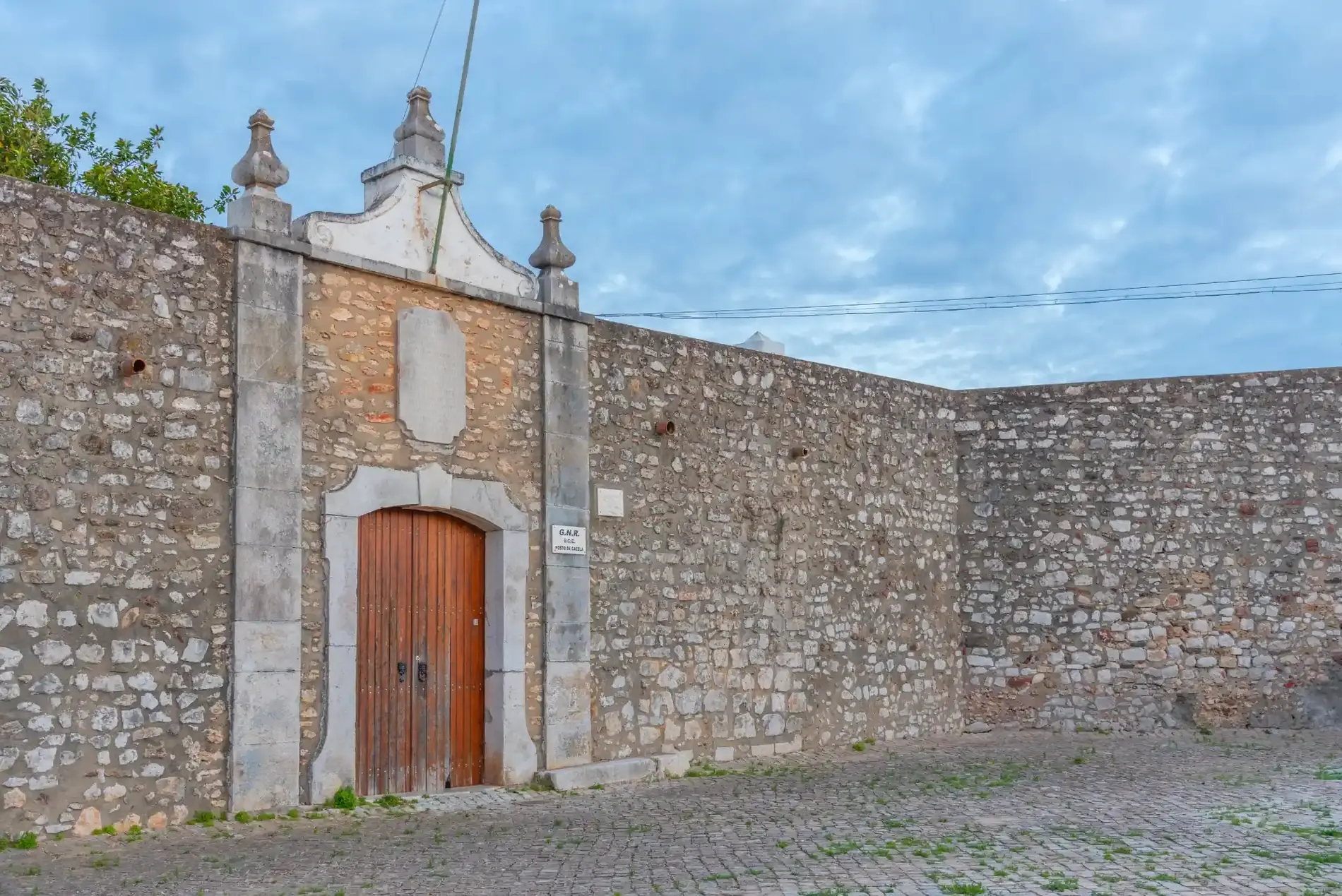
The fort had a more troubled history. The fortification was rebuilt in the 16th century by order of King João III or King Sebastião — the latter reportedly inspected the works in person in 1573. By 1617 the walls on the cliff side were already in ruins, and by 1750 the fortress was derelict, even before the 1755 earthquake damaged it further. Reconstruction, ordered in 1770 by the Algarve's governor, D. Rodrigo de Noronha, was only completed in 1794 under the governorship of Nuno José de Mendonça e Moura, Count of Vale de Reis, based on a 1784 plan by engineer José Sande de Vasconcelos. That is the star-shaped structure, with two bastions facing the sea, seen today — small, because of the site's limited space (Wikipedia – Fortaleza de Cacela; DGPC). The church was rebuilt in 1795 (Wikipedia).
From the abolition of the municipality to the Liberal Wars (1775–1833)
As part of an administrative reform of the Algarve, the municipality of Cacela was abolished on 12 December 1775, by decree of King José I, and its territory joined that of the newly created Vila Real de Santo António; the priory of Cacela had already been moved there the year before. Around 1784, the parish of Cacela is thought to have been created by splitting off from the parish of Vila Real de Santo António — Wikipedia itself flags this date with a question mark, as uncertain (Wikipedia).
On 24 June 1833, in the midst of the Portuguese Civil War, a Liberal force of about 2,500 men under the Duke of Terceira landed near Cacela, by the Torre Velha, at the eastern edge of the parish. After crossing the Algarve and the Alentejo while evading the Miguelist army, that force entered Lisbon in triumph exactly one month later, on 24 July (Wikipedia).
From the fiscal guard post to heritage listing (1897–2010)
Later, in 1897, the fort's facilities were taken over by the Guarda Fiscal (fiscal guard), whose duties are now carried out by the GNR's Fiscal Brigade; the building remains in use by that force and is not open to visitors (Wikipedia – Fortaleza de Cacela).
The listing process for the historic core began with a proposal from the then Instituto Português do Património Cultural (IPPC) on 23 October 1986, with a favourable opinion from the IPPC's Advisory Council on 30 December 1986 and approval by the Secretary of State for Culture on 15 January 1987. The formal listing as a Property of Public Interest was only published ten years later, by Decree no. 2/96, in the Official Gazette of 6 March 1996, covering the fort, the parish church and the Santa Rita chapel as a group. In 2010, the corresponding Special Protection Zone was defined, by Ordinance no. 83/2010 and its republication as Ordinance no. 264/2010 (DGPC).
What archaeology has revealed (1998–2022)
Between 1998 and 2001, excavations at Poço Antigo uncovered an Islamic residential quarter from the first half of the 13th century, of the Almohad period, with houses arranged around a paved central courtyard, with a kitchen, bedroom and latrine. Above that quarter, a medieval Christian cemetery was identified, with 56 burials (CIIPC).
A new campaign in July 2018, coordinated by Maria João Valente (University of the Algarve) and Cristina Tété Garcia (Algarve Regional Directorate for Culture), with teams from the University of the Algarve and Simon Fraser University (Canada), found 11 more burials in that same cemetery, dated approximately to the 15th–16th centuries — among them one with a scallop-shell pendant, a possible sign of pilgrimage or membership of the Order of Santiago. The research project, with a total budget of around 300,000 euros, was due to run until 2022 (Público, 2018).
Cacela Velha today
The historic core of Cacela Velha has been listed as a Property of Public Interest since 1996, has had a Special Protection Zone since 2010, and lies inside the Ria Formosa Natural Park. There is no new construction within the core, the fort remains in use by the GNR and closed to visitors, and the village lies on the eastern route of the Portuguese Way of Saint James (Wikipedia). To visit today, see the guide things to do in Cacela Velha and how to get to Cacela Velha.
Sources
- Direção-Geral do Património Cultural (Portugal's heritage authority) — listing record for Cacela Velha (ensemble)
- Wikipedia (Portuguese) — Cacela Velha
- Wikipedia (Portuguese) — Igreja Matriz de Cacela-Velha
- Wikipedia (Portuguese) — Fortaleza de Cacela
- PlanetAlgarve — Os 730 anos do Foral de Cacela
- CIIPC (Centro de Investigação e Informação do Património de Cacela) — Cacela islâmica
- Notícias de Arqueologia — Medina islâmica do século X descoberta em Cacela-Velha
- Público, 21 July 2018 — "No cemitério medieval de Cacela Velha já se tratavam os recém-nascidos com dignidade"
- TAHIRI, Ahmed (2009), Cacela e o seu poeta Ibn Darraj al-Qastalli na História e Literatura do Al-Andalus, Vila Real de Santo António municipal council — summary on Academia.edu
Found an error, or have an extra source? Get in touch via our contact page.