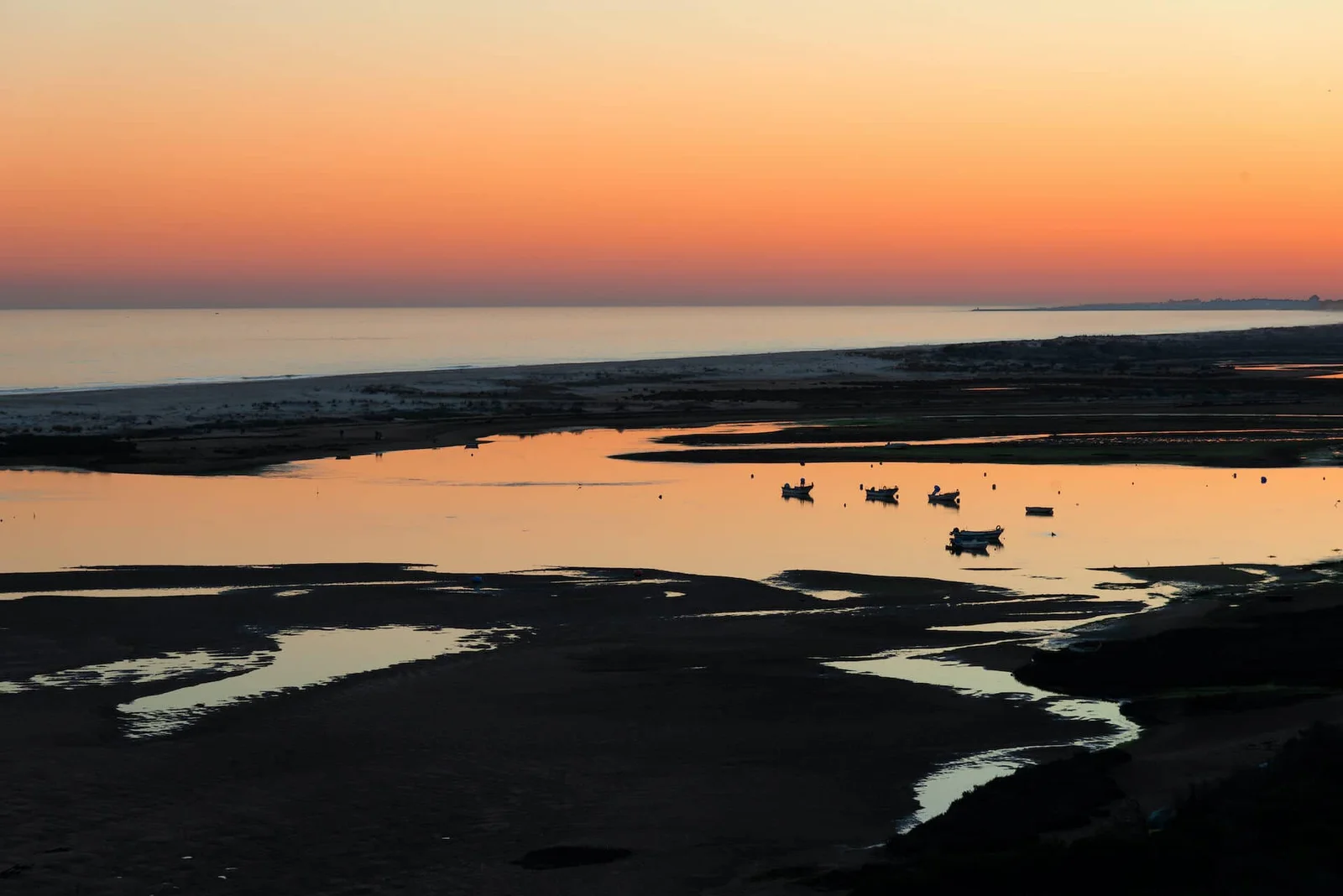
Real month-by-month weather, the best season for birdwatching on the Ria Formosa, dog-friendly beaches and lower prices: the complete guide to low season in Cacela Velha.
Summer brings the crowds, but autumn and winter reveal a different Cacela Velha: quieter, cheaper and, for anyone who likes birds, far more interesting. This guide focuses specifically on the low-season months (November to March) — for an overview of every month, see the guide when to visit Cacela Velha.
Quick answer
- Temperature: mild autumn (average 19.6ºC in October, 15.7ºC in November); gentle winter, with average lows between 8ºC and 11ºC and average highs between 16ºC and 19ºC.
- Sunshine and rain: around 5 to 6 hours of sun a day between November and February; contrary to what's sometimes said, the wettest months are November and December, not January and March.
- Birds: the best season for birdwatching on the Ria Formosa, with over 30,000 wintering waterbirds, including flamingos.
- Beaches: no restrictions on dogs outside bathing season, and no crowds or parking problems.
- Prices: usually lower, with more accommodation available.
- Worth checking: the sea isn't for swimming, and some restaurants reduce their hours — confirm before you go.
The real weather, by month
The Algarve has a Mediterranean climate, with mild winters. According to the official IPMA climate normals for Faro, 1991-2020 period, the average daily temperature is around 19.6ºC in October and 15.7ºC in November; in the colder months, the average low ranges from 8.3ºC (January) to 10.8ºC (March), and the average high from 16.3ºC (January) to 18.9ºC (March). Contrary to what's sometimes claimed, the wettest months aren't January or March: they're November and December, averaging 75.5 mm and 90 mm respectively, against 49.3 mm in January and 46.8 mm in March. As for sunshine, IPMA's older normals (1971-2000) — the most recent period doesn't publish this figure — point to around 5 to 6 hours of sun a day between November and February.
In practice, it's too cold for the sea but good for walking, cycling and photography — bring a jacket for the evening and for the wind off the lagoon.
The best season for birdwatching on the Ria Formosa
If there's one strong reason to visit Cacela Velha out of season, it's this: in winter, the Ria Formosa hosts over 30,000 waterbirds (Aves de Portugal). Wintering species include flamingos (best viewed between November and March), wigeon, shoveler, teal, dunlin, curlew, grey plover, spoonbill and glossy ibis.
It's no coincidence: ADRIP, the association that protects Cacela's natural heritage, has taken part in EuroBirdwatch, the European birdwatching weekend, for over a decade — with editions in Cacela documented since 2013 (record of the first year), always in October, as a partner of SPEA (the Portuguese Society for the Study of Birds), with a walk through the Sapal Nature Reserve. See the ADRIP page for upcoming events. To explore the lagoon on your own, read the Ria Formosa guide and compare boat trips.
Beaches with no restrictions for dogs
Sotavento beaches ban pets during bathing season (normally June to September), but that ban no longer applies outside it. If you're travelling with a dog, autumn and winter are by far the best time to walk the beach together. See the full rules in the Dog-Friendly Cacela Velha guide.
No queues, no full car parks
In summer, the small car park at the entrance to Cacela Velha fills up before 10am. Out of season, that simply doesn't happen — arrive whenever you like. See the how to get to Cacela Velha guide for all transport options.
Lower prices, more availability
Outside July, August and September weekends, accommodation prices in the region drop and there's more choice, even close to the date. Compare areas in the where to stay near Cacela Velha guide and see when to book in when to visit Cacela Velha.
What to check before you go
In a village as small as Cacela Velha, some restaurants and service providers reduce their hours or close out of season. Before planning your trip around a specific restaurant or tour, confirm it's open — see the best restaurants near Cacela Velha.
What to do in autumn and winter
- Birdwatching and walks around the Ria Formosa.
- Cycling around the Eastern Algarve: mild temperatures, ideal for riding without the summer heat.
- Golf: the Algarve's mild winter is one of the reasons the region draws golfers year-round.
- A walk through the village and the fort, with winter light that's great for photography.
Ready to plan?
See the weekend in Cacela Velha itinerary and the when to visit guide to pick the right date within the low season.
See all places to stay or compare prices: Booking.com · Hotels.com · Vrbo. To get there by car, compare rental from Faro Airport.